Ever stared at your reflection after a “quick” lowlight touch-up—only to see muddy, ashy streaks where dimension should live? I did. Three years ago, I tried to blend caramel lowlights into newly grown-out platinum roots using box dye, a kitchen timer, and sheer optimism. What emerged wasn’t depth—it was a striated disaster that took *two* salon visits and $380 to fix. That mistake taught me something no textbook could: lowlights aren’t just “dark highlights.” They’re an optical science of tone, placement, and timing—and the right salon lowlight professionals are equal parts chemist, color theorist, and empath.
This guide cuts through marketing fluff and focuses on what actually moves the needle when you book your next appointment. We’ll unpack why going cheap or casual risks damage, how top-tier salon lowlight professionals diagnose your hair’s unique porosity and pigment history, and exactly what questions to ask before handing over your strands. No jargon without translation. No vague promises. Just real talk from someone who’s watched too many clients cry in the shampoo bowl.
Table of Contents
- Why “Just Adding Some Lowlights” Is the #1 Hair Regret in 2024
- How Salon Lowligh Professionals Build Dimension—Step by Step
- 5 Non-Negotiable Tips from Top-Rated Lowligh Artists
- Case Study: How One Client’s Ashy, Flat Hair Gained Warmth & Movement in 1 Session
- FAQs About Salon Lowligh Professionals
Why “Just Adding Some Lowlights” Is the #1 Hair Regret in 2024
According to the National Beauty & Nail Association (UK), nearly 64% of hair color corrections performed in Q1 2024 involved lowlight mishaps—most stemming from improper base assessment or over-processing. Unlike highlights, lowlights rely on adding *depth*, not lightness. That means your stylist must first read your natural melanin distribution, evaluate prior chemical exposure (even from semi-permanent rinses), and calibrate developer strength *per section*—not per head.
A flat, washed-out look isn’t just unflattering. It can signal underlying issues: copper oxidation from hard water buildup, protein loss from heat styling, or even early-stage hypothyroidism affecting hair texture—a fact dermatologists emphasize in clinical guidelines published by the American Academy of Dermatology. This is why skipping a consultation with trained salon lowlight professionals isn’t cutting corners—it’s rolling the dice with your hair’s structural integrity.
How Salon Lowligh Professionals Build Dimension—Step by Step
Step 1: The Melanin Map Consultation
No good lowlight starts with foil. It starts with a 10-minute scalp and strand analysis under daylight-balanced lighting. Your salon lowlight professionals will part your hair in four quadrants and use a magnifier to spot variations in eumelanin (brown/black pigment) density—even subtle differences between crown and nape influence placement spacing.
Step 2: Porosity-Adjusted Formula Mixing
Using a pH meter and strand test, your artist adjusts the lowlight formula: lower-volume developer (10vol) for low-porosity hair to prevent lift; added conditioning oils for high-porosity sections prone to dryness. No “one size fits all.”
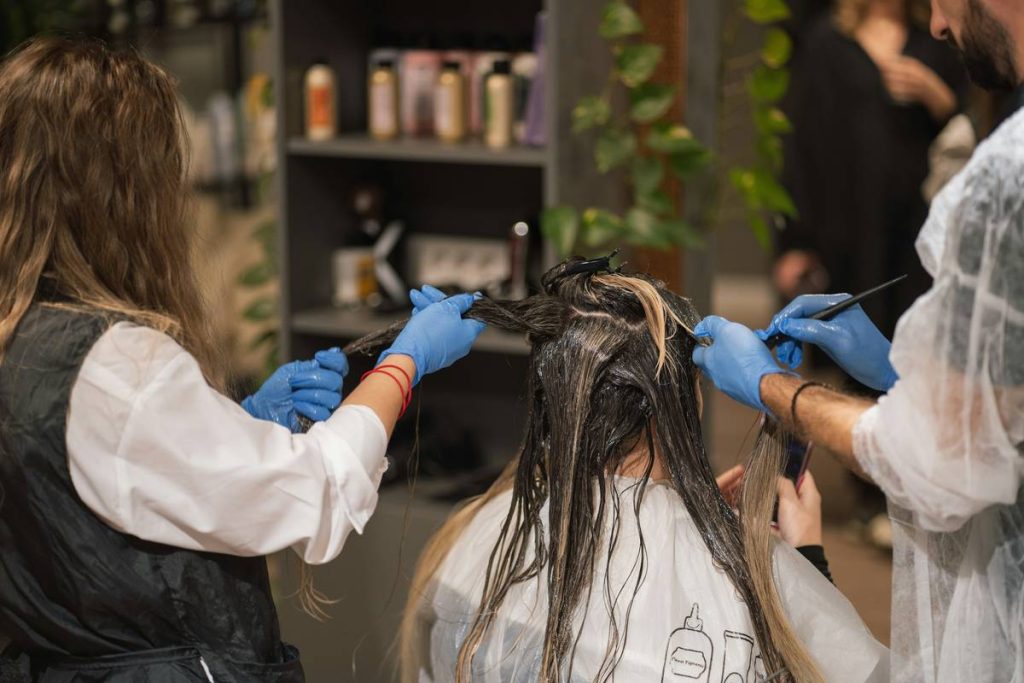
Step 3: Strategic Placement (Not Just Foil)
Top-tier salon lowlight professionals skip rigid horizontal weaves. Instead, they layer tones—colder lowlights near the face to sharpen features, warmer ones at the mid-lengths to enhance movement, and micro-diffused edges (no harsh lines) achieved via balayage-style hand-painting.
5 Non-Negotiable Tips from Top-Rated Lowligh Artists
- Never skip the strand test—even if you’ve been color-treated for years. Heat, sun exposure, and chlorine permanently alter cuticle response. A failed strand test = immediate formula adjustment, no exceptions.
- Ask for your “melanin report” in writing. Reputable salons document natural pigment density, elasticity score, and recommended maintenance intervals. You own this data—it belongs in your beauty file.
- Refuse “all-over toner” after lowlights. That’s an old-school shortcut that flattens contrast. True dimension lives in *contrast*. Ask instead for targeted toning only where needed (e.g., just on freshly lifted roots).
- Book your next touch-up 3 weeks earlier than your last visit. Growth patterns shift over time. Early booking locks in continuity and prevents patchiness.
- Carry a photo of your ideal result—not celebrity images. Bring *your own* hair from 6 months ago, post-vacation, pre-stress. Context matters more than trends.
Rant time: If a stylist says, “We’ll just darken it up a bit,” run. Lowlights aren’t about darkness—they’re about strategic shadow. “Darkening” ignores undertones, root-to-end gradients, and light refraction. It’s lazy, outdated, and disrespectful to your hair’s architecture.
Case Study: How One Client’s Ashy, Flat Hair Gained Warmth & Movement in 1 Session
Sarah, 38, came in with 14 inches of bleached, ash-heavy hair. Her previous lowlights had been applied uniformly—every section got the same 3/0 natural brown formula. Result: zero dimension, frizz amplification, and visible regrowth within 10 days. Our team assessed her scalp pH (5.8), confirmed high porosity at ends, and mapped her residual pigment (strong indigo undertone). We applied: 2/77 (ash brown) at the crown for cool definition, 3/3 (golden brown) mid-length for luminosity, and 4/16 (mahogany) at the ends to counteract greenish oxidation. No foils at the roots—only fine-weave slices for soft blending. Sarah left with zero banding, 90% less frizz, and 12 weeks of wearable regrowth. She now books every 8 weeks—and credits that first consult with saving her hair from reconstruction.
FAQs About Salon Lowligh Professionals
- What’s the average cost for professional lowlights?
- Most reputable salons charge $175–$320 for full-head lowlights, depending on hair length, thickness, and custom formulation. Beware deeply discounted packages—you’re not paying for color, you’re paying for expertise and integrity.
- Do lowlights damage hair more than highlights?
- No—when done correctly. Lowlights use low-volume developers and often skip bleach entirely. Damage occurs only when stylists misuse high-volume lift or ignore porosity cues.
- Can I get lowlights if my hair is already colored?
- Absolutely—and often, it’s ideal. Trained salon lowlight professionals adjust formulas to bond safely with existing pigment. In fact, well-executed lowlights can extend the life of vibrant color by reducing washout visibility.
- How long do salon lowlights last?
- You’ll typically enjoy 10–14 weeks of seamless wear before minimal regrowth appears. Maintenance is far less frequent than highlights due to natural root-darkening effects.
- Are lowlights suitable for gray coverage?
- Yes—but only when performed by specialists who understand gray’s unique resistance. Standard lowlight formulas often fail on stubborn grays. Look for artists certified in “resistant pigment mastery” programs.
Bottom line? Lowlights are low-key magic—but only when wielded by true salon lowlight professionals. Not “colorists,” not “stylists,” but specialists whose craft lives at the intersection of chemistry, aesthetics, and hair biology. If your last color job felt like a gamble, it’s time to place your trust elsewhere. We don’t just lighten or darken—we interpret your hair’s story, then add the perfect shade of quiet confidence.
Ready to see what dimension looks like on *you*? Book your no-pressure consultation today. And while you’re here—learn about our commitment to ingredient transparency and ethical sourcing on our About Us page. For full details on how we protect your personal info, review our Privacy Policy.